Documentation · Curating
Working with SQL statements
The fourth surface is your own SQL: statements you wrote, tested and chose to expose. The agent never composes SQL and never sees a SQL prompt — it calls a tool you named, with parameters you defined.
One config entry yields one tool, so declining to select a statement is the control, exactly as for sequences.
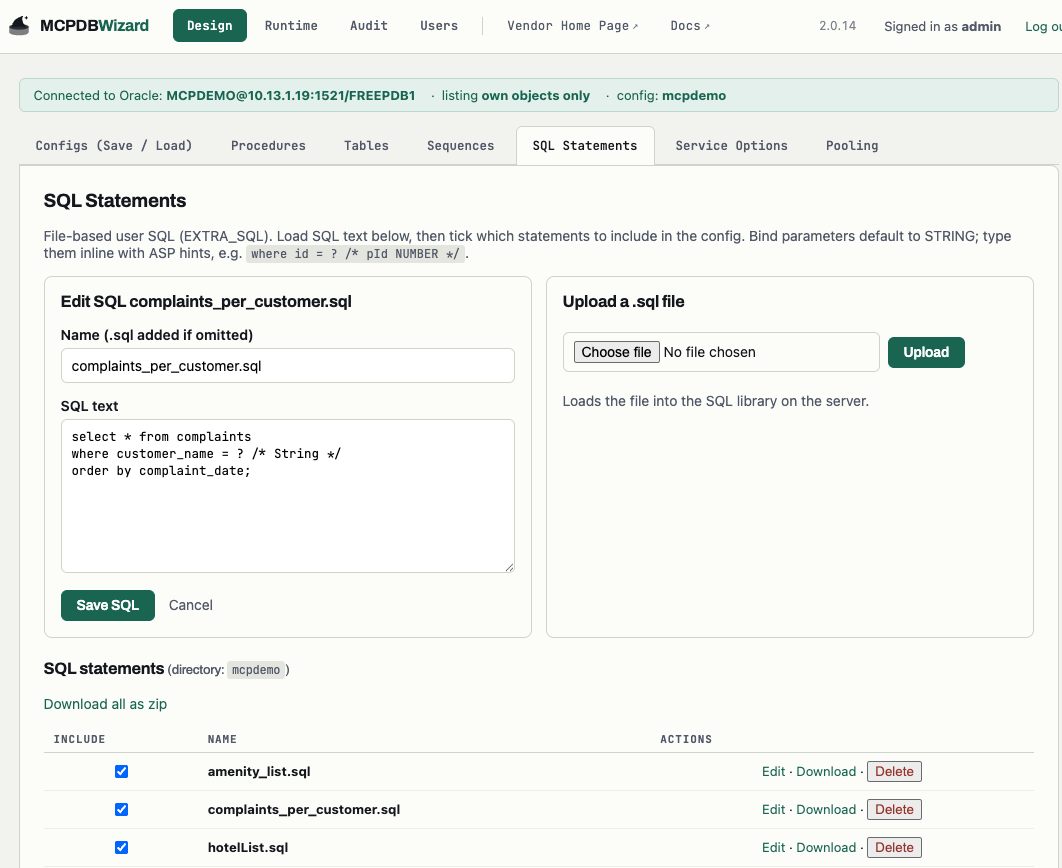
GetFlights.sql. Bind parameters are typed inline with ASP hints — ? /* city string */ — and the comment is how a ? gets a name and a type in the generated tool.Test your SQL statements elsewhere first
Write and test the statement in SQL Developer, SQL*Plus or whatever you normally use, against realistic data, before it goes anywhere near a config. The generator’s job is to expose the statement you gave it — it will not tell you the query is wrong, slow, or returns the wrong rows.
Specifically, check before you expose:
- It returns what you meant on realistic data volumes, not on three test rows.
- Its plan is acceptable and it uses the indexes you think it does. An agent may call it far more often than a human would.
- It behaves at the edges: no rows, null parameters, the largest result you can imagine an agent asking for.
- You are content for it to run as written. A selected statement is exposed as written, destructive DML and DDL included. That is by design.
Pair this with DAO_QUERY_TIMEOUT_SECONDS — see Session management — so a
statement that misbehaves in production stops rather than holding a connection.
Naming parameters and giving them types
A bind variable’s name becomes the tool’s argument name, and its declared type becomes the argument’s JSON type. Both are worth choosing deliberately: they are what the model reads.
-- Vague: an agent has to guess what :1 and :2 are
SELECT * FROM orders WHERE cust_id = :1 AND created > :2

-- Better: the names are the documentation
SELECT order_id, order_date, total_eur
FROM   orders
WHERE  customer_id = :customer_id
AND    order_date  > :placed_after
Name parameters as you would name a function’s arguments, not after the column they happen to filter. Then add a tool description saying what the statement answers and when to use it — that is what decides whether the model picks this tool or a different one.
To write. The exact syntax for declaring a parameter’s datatype in a config; worked examples for each type; what happens with a parameter used twice; how result columns are named.
Supported data types
| Oracle | JSON |
|---|---|
NUMBER | number |
VARCHAR2, CHAR, CLOB | string |
DATE, TIMESTAMP | ISO-8601 string, yyyy-MM-dd'T'HH:mm:ss |
RAW, BLOB, binary VECTOR | base64 string |
JSON (23ai) | object |
BOOLEAN (23ai) | boolean |
dense VECTOR | array of numbers |
| PL/SQL record, SQL object type | object, keyed by field |
| PL/SQL collection | array |
| ref cursor (OUT) | array of row objects |
Not crossable, so not exposed: SDO_GEOMETRY, BFILE, IN ref cursors, FLOAT16 vectors, and
timestamps with time zones on the table-row path. Anything using one is skipped whole, and the
generation log says which and why.
Schemas are strict
Tool schemas set additionalProperties: false, so a misspelled argument is rejected before the
handler runs and the database is never touched. The refusal still comes back as a result with
content, so it can look like a call that ran — check argument names against tools/list.